
My relationship with Game Design has grown more over years of identifying what can be considered a game. A specific idea for a game had been tinkering in mind all summer and has led me to the area of study I have chosen to focus on – Digital Avatar Customization in Simulated RPG’s. Originally, a journal I have been recreating over a decade has proven to be a self-help tool for me however I longed for a digital and portable version with easy input and fun. The absence of such a tool encouraged me to observe the function of a journal itself and whether it could be considered a game. In this research I’ve explore selective relevant studies into the gamification of identity and executing a self-help game that encompasses the essential meaningful play.
At first when encountering Rules of Play by Salen and Zimmerman, it appears my game concept didn’t align with enough rules to make it meaningful – majorly because there was no real challenge and there was no suspension of desire that seduces the player to continue. Besides, how does one make a journal a game? Despite this, close observation to the freedom and nature of a journal compared to free moving games such as Grand Theft Auto or Little Big Planet reveals that the type of character mimicry and world navigation is what could link the journal to Game Design. The elements of my journal included a self portrait (stylized with a cartoony effect), pages identifying personal goals, a timeline and a vision board which accumulated inspirational photos for motivation.
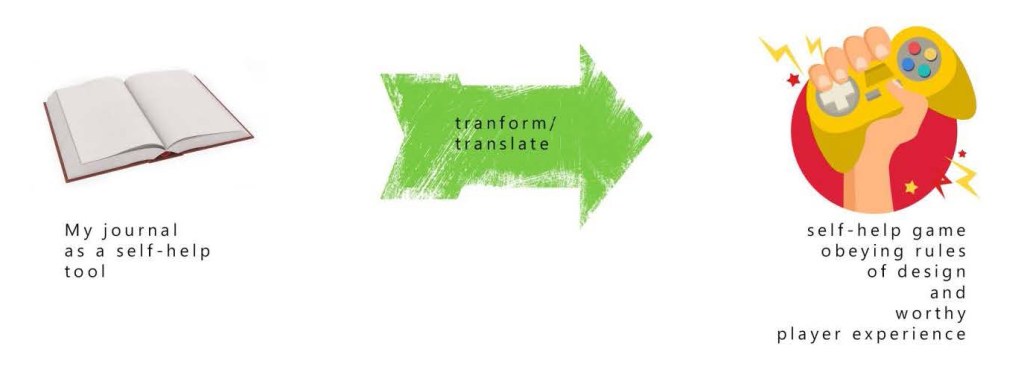
The journal has been more and more successful as a tool in my life, simultaneously giving strength to the theory of mirror psychology – being able to reflect on ourselves helps to develop sophisticated self-representation and that without self-reflection our sense of self diminishes leaving us with many variants of identity crises. This is a transferable theory present in games and (player) identification in a game has been essential even before digital avatars as they are evident in board games in the form of tokens, pawns and counter-pieces.
Christine Blackman from Stanford News conducted a research into whether avatars can change the way we think and act. “If you saw a digital image of yourself running on a virtual treadmill, would you feel like going to the gym? Probably so, according to Stanford study showing that personalized avatars can motivate people to exercise and eat right.” In this way, it would be beneficial for players to drive change into their immediate life just by stimulating parts of the brain that identify themselves with the character they’re playing and the actions and environment that surrounds them.
DO WE LOVE TO BE CARICATURED AND CARTOONISED?
Bitmoji is the personalised emoji which has a growing library of personal features to choose from. This mobile app has similar qualities to RPG avatar customisation. Bitmojis function across other social media platforms such as Facebook and Instagram. This gives meaning to the personalised avatar as a means of communication, as opposed to just being static in a single app. The steady growth of users makes sense since, like emoji’s, Bitmojis fill a gap that people didn’t know existed. Identity is at the heart and our digital life is merging with our physical lives. Digital avatars are a way of communication and evolution; to me this is a timeless trait inherent with RPGs.
In cartoons and animation there is a spectrum of symbolic representation. On one end you have a photo of yourself, the most realistic representation. On the other hand is the smiley face, which could be anybody or everybody. It’s all about finding a balance. If you are too generic, you have no meaning. If you are too realistic, it gets creepy. The stylization of our digital identity is a big part of why people love it. And maybe it doesn’t look exactly like us, but it’s enough that it represents ourselves. In this way, digital avatars, particularly in the game I intend to design, can be used aspirationally so that players can be what or more importantly who they desire to be.

To be represented with digital avatars is important for self-belief and identity establishment. This has been proved by the collaboration between Advertising agency Ogilvy Paris and Unilever’s Dove who together created curly haired emoji’s. The fact that these emoji’s and even the Bitmojis aren’t exactly interactive but more assisting text as a fixed image tool is evidence enough of the effect of digital representation on our self-image. If there was a gamification of self-improvement using the emoji’s that we feel narrate and express ourselves so well, the odds are in favour of it being well received. It may be hard to see emoji’s addressing a significant social problem, but Unilever VP-Haircare Marketing Rob Candelino believes they can. “When 73% of people in this country claim to use emoji’s every day, they’re very quickly becoming the new currency of communications,”
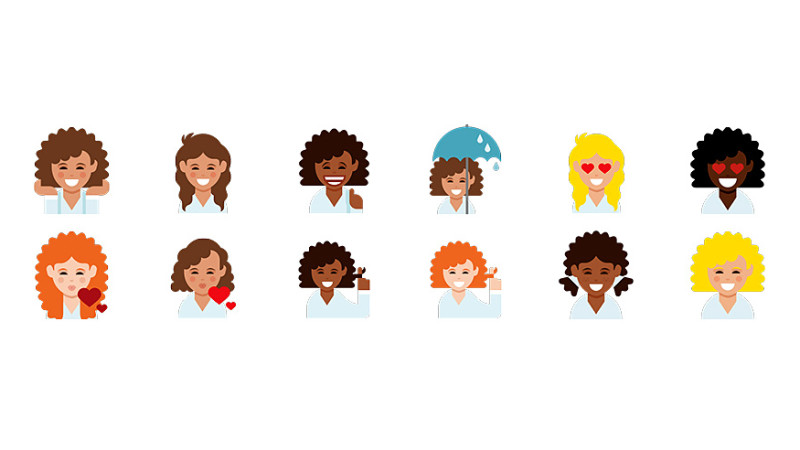
https://adage.com/article/digital/dove-launches-curly-haired-emojis-address-void/301203
Bibliography:
Salen, K. & Zimmerman, E. (2003) Rules of Play. Massachusetts, MIT Press.
Livinstone, M. (2002) Vision and Art: The Biology of Seeing. New York, Abrams Books.
Crawford, C. (2003) Chris Crawford on Game Design. San Francisco, Peachpit Press.
McRaney, D. (2011) You Are Not So Smart. United Kingdom, Oneworld Publications.
Nicholas Taleb, N. (2012) Antifragile: Things that Gain from Disorder. United States, Random House
Fox, J., & Bailenson, J. N. (2009). Virtual self-modeling: The effects of vicarious reinforcement and identification on exercise behaviors. Media Psychology, 12(1), 1–25.
Yee, N. (2007). The proteus effect: Behavioral modification via transformations of digital self-representation (PhD thesis). Stanford University.
16 Personalities 2011, Free Personality Test, NERIS Analytics Limited. Available from:
https://www.16personalities.com/free-personality-test/ [01 November 2018]
AdAge 2015, Dove Launches Curly Haired Emoji’s to End Straight-Haired Dominance. Available from: https://adage.com/article/digital/dove-launches-curly-haired-emojis-address-void/301203/ [01 November 2018]
The psychologist 2010, Mirrors and the Mind. Available from:
https://thepsychologist.bps.org.uk/volume-23/edition-2/mirrors-and-mind [29 October 2018]
Cyberpsychology 2015, The effects of customisation. Available from:
https://cyberpsychology.eu/article/view/4340/3412/ [29 October 2018]
Stanford News 2010, Can avatars change the way we think and act? Available from:
https://news.stanford.edu/news/2010/february22/avatar-behavior-study-022510.html/ [29 October 2018]
Canupy 2016, Why Bitmoji is becoming” the uber of” digital communication. Available from:
http://canupy.com/blog/why-bitmoji-is-becoming-the-uber-of-digital-communication/ [29 October 2018]
Discover more from Posie Lombardi Rodriguez
Subscribe to get the latest posts sent to your email.
